Yorkshire dialect stands out from other dialects in Great Britain due to its unique linguistic features.
Here are provided three groups of linguistic features of Yorkshire dialect.

Pronunciation

Grammar
Vocabulary
Pronunciation
- Yorkshire is considered as Northern accent and is non-rhotic, meaning the /r/ sound is not pronounced.
- The sound /ʌ/ changes into a short sound /ʊ/.
For example, in words such as strut, cut, blood, lunch (World Heritage Encyclopedia, 2018). - the diphthong /ei/ is often pronounced as a long /ɛː/ sound (Huges A.& P. Trudgill, Watt.D 2012: 104.
For example, in words late, face, say, game. - One more important aspect of Yorkshire pronunciation is that in words, which end in -y, Yorkshire speakers the long /i:/ changes into shot /i/, for example, in words like “city and many” (WHE 2018), happy and shiny.
Grammar
- Definite article reduction (DAR). This happens, when the article “the” is shorten to ” ‘t”’ or replaced by a glottal stop (when pronounced).
For example, t’most precious in t’hear. - Usage of personal pronouns:
“Ah, I; mah, my; thoo or tha, thou; thah, thy; hor, her; oor, our; yer”. (Ross, Stead & Holderness 1877: 6).
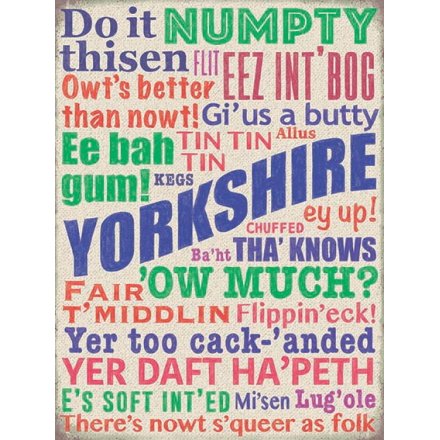
Vocabulary
- Addle – to earn something.
- Cat Hawed – drunk.
- Flake -a hurdle.
- Flaycrow – scarecrow.
- Lad – a guy.
- Lass – a girl.
- Lea – a scythe.
- Pike – a small stack of hay.
- Slape – slippery.
- Stoops – gateposts.
- Stower -a rung (of a stee ladder).
- Yoon – an oven.
 'Eh up! Yorkshire Dialect and Literature